
Health
Ghana: Africa’s New Leader in AI Healthcare– Dr Donkor

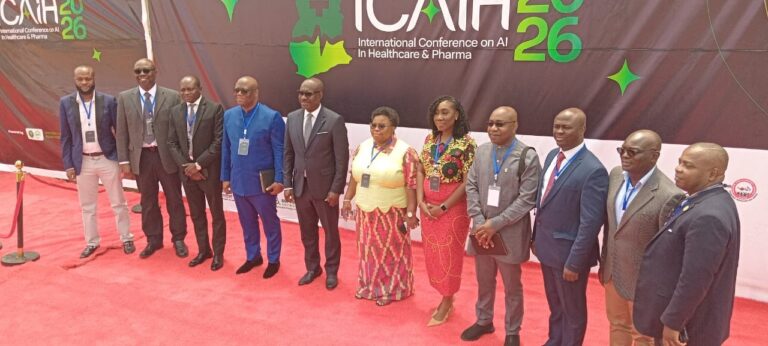
Ghana is positioning itself as a continental trailblazer through its Artificial Intelligence (AI) for Health Programme, which was launched in partnership with the World Health organization (WHO) and other UN agencies.
Dr George Agyekum Donkor, the President and Chairman of the Board of Directors, ECOWAS Bank for Investment and Development (EBID) who made the comment, said the initiative was targeted at strengthening disease surveillance, improving health system resilience and promoting responsible adoption of AI across the health value chain.
Dr Donkor who was the keynote speaker at the International Conference on AI in Healthcare and Pharma, at the University of Health and Allied Sciences (UHAS), Ho, said this enterprise aligned with the country’s Artificial Intelligence Strategy 2025-2035, while commending partners for this conference.
The three-day conference being hosted by UHAS is themed, “Transforming Healthcare from Expenders to ‘Healthpreneurs’: Leveraging AI as the Bedrock for Regional Cooperation.”
The President of EBID Bank said Africa was making giant strides in competition for the AI space with Zipline and mPharma leading the pact with the world’s largest autonomous medical drone delivery networks, combining AI, robotics and predictive inventory management of blood and other medical and laboratory deliveries, as well as supply chain management to forecast medicine demand and optimise inventory.
He added that Helium Health, in Nigeria, was also making concerted waves in health technology with its AI-electronic medical records, hospital management systems and predictive analytics, which sought to automate administrative processes and provide data.
He said these and other tailor-made tech amplified the fact that Africa was not wholesale consuming technology developed elsewhere, but were continental entrepreneurs, and researchers developing globally tested solutions to compete.
Dr Donkor emphasised that AI could not reach its optimum through national efforts alone without accessing quality data, interoperating with digital infrastructure, trusted governance and harmonised regulation.
“For ECOWAS, this is the opportunity to build a truly integrated regional digital health ecosystem powered by a common digital agenda,” he said.
He suggested the establishment of an interoperating electronic health record systems with strong cybersecurity structures, adoption of harmonised standards for health data governance and the designation of centres of excellence linking universities, teaching hospitals, research institutions, private innovators to advance AI research.
Again, Ghana must urgently equip the next generation of clinicians, biomedical engineers, data scientists and entrepreneurs with the required skills to drive Africa’s health tech revolution.
Dr Donkor said these gave credence to the concept of ‘Healthrepreneurs,’ who became the lead agents for transformation and advancement.
He underscored that countries leading the AI transformation shared one trait of consciously investing not only in AI but institutions that enabled it.
Prof. Lydia Aziato, the Vice-Chancellor of UHAS, urged partners to make AI learning platforms available to students at the institution and announced plans to integrate AI, telemedicine and other digital technologies into the proposed UHAS Medical Centre to improve diagnosis, personalised treatment and healthcare delivery.
She, however, stressed that AI must always be used ethically, respecting the privacy of patients, data security and professional standards, noting that technology could never replace human judgement and compassionate care.
Prof. Aziato proposed the establishment of an AI Centre of Excellence at UHAS to advance research in areas such as clinical trials, drug development, sustainable health financing and health leadership, while training practicing health professionals and students from other institutions as well.
The Vice-Chancellor reaffirmed UHAS’ readiness to collaborate with local and international institutions to build a modern health innovation ecosystem for Ghana and beyond.
Prof. Alexander Ansah Manu, the Director of the Institute of Health and Research (IHR), UHAS and Epidemiologist, said ICAIH aimed at translating Ghana’s recently launched National AI Strategy into practical interventions for the health sector.
He said the conference would also feature high-level technical discussions involving the Ministry of Health, World Health organization (WHO), National Vaccine Institute, Food and Drugs Authority (FDA), National Health Insurance Authority (NHIA), Centre for Plant Medicine Research, Institute of Traditional and Alternative Medicine, the Ghana Health Service and AI experts.
The discussions would focus on applying AI to maternal, newborn, child and adolescent health, strengthening clinical trials, vaccine and drug production, improving sustainable health financing and addressing leadership challenges in the health sector through innovative digital solutions.
He expressed the hope that the forum would produce a shared national roadmap for AI adoption in healthcare while fostering partnerships among researchers, innovators, policymakers, and industry.
The main theme of the ICAIH conference is: “Accelerating Adoption of Healthcare AI in Ghana: From Vision and Policy to Practice and Impact,” and the key partners included WHO, UNESCO, UNICEF, Health Facilities Regulator Agency (HEFRA), FDA, UGBS, UG, KATH, MOH, adb, Microsoft, Melcom, AU, EBID, Africa CDC among others.
Source: GNA