
Business
President Mahama instructs Energy Minister to pay for Ghana’s crude oil for TOR using cedis instead of dollars

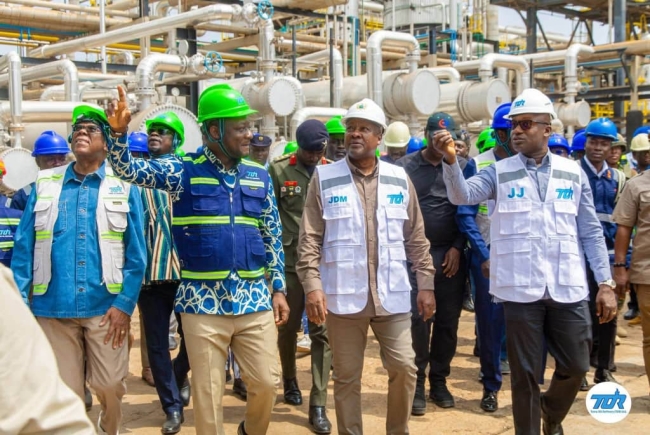
President John Dramani Mahama has instructed the Minister of Energy to “rethink and take a second look” at how the Tema Oil and Sentuo refineries can pay for Ghana’s indigenous crude oil using the local currency, the Ghana cedi, rather than the US dollar when they take delivery of the oil produced locally offshore in the Western Region.
The Minister of Energy and Green Transition, John Jinapor made this known when he spoke at the commissioning of the refurbished Crude Distillation Unit (CDU), the Residue Fluid Catalytic Cracking Unit (RFCC), a 120-ton steam boiler, a new F-61 Crude Heater and other upgraded facilities of the state-owned Tema Oil Refinery (TOR) on Saturday (August 1, 2026).
The ceremony also marked the official receipt of one million barrels of Ghana’s indigenous Jubilee Medium Sweet Crude delivered to TOR aboard the MT Apache for local refining.
Dr John Jinapor, said President Mahama had questioned why TOR and Sentuo take the crude, process and sell in Ghana cedis but had to pay for it in US dollars.
According to Mr Jinapor, they were at a meeting at “President Mahama’s house” with the Governor of the Bank of Ghana and Minister of Finance in attendance when he [President] asked about the payment arrangement, and he brought “another angle.”
“Jinapor, so when Tema Oil Refinery and Sentuo take the oil, how do they pay?” President Mahama reportedly questioned the minister.
According to the minister, he explained to President Mahama that “in accordance with the Petroleum Holding Fund and in accordance with the Petroleum Revenue Management Act, they have to go and look for dollars and pay in foreign currency.”
“He [Mahama] gave me [Jinapor] instructions and fortunately, the Finance Minister and the Governor [of Bank of Ghana] were around, he said, “rethink, take a second look at it, when Tema Oil Refinery takes the crude and they process and sell it in Ghana cedis, why don’t we pay Ghana cedi into that account [of Petroleum Holding Fund] and use our own cedi rather than going to the forex and buying dollars.
And then the Governor said, yes, Mr President, you are right, because when we go to the market and we buy forex, we put pressure on our currency; we add cost to it, so next week let’s have a meeting so that we can structure that, Mr Jinapor quoted the Governor as saying.
Crude oil is priced and traded internationally in United States dollars under standard industry practice.
Companies that own and sell crude, including stakeholders in Ghana’s Jubilee, Bonga and Baleine fields, invoice in dollars regardless of where the oil is produced or refined.
The requirement to pay in dollars is also provided for under Ghanaian law. The Petroleum Holding Fund and the Petroleum Revenue Management Act require TOR and Sentuo Refineries to obtain and pay in foreign currency for crude oil, including crude produced in Ghana.
Addressing the ceremony, President Mahama said TOR had received three separate cargoes of one million barrels of crude oil since May this year. They were Bonga crude, Baleine crude and Ghana’s Jubilee Medium Sweet crude.
He said two million barrels had already been processed into petroleum products, while payment for the Jubilee crude cargo had been made in full.
President Mahama directed the Minister of Energy and Green Transition to work with the TOR Board and management to prepare a strategic plan to increase the refinery’s processing capacity to 100,000 barrels a day.
He said the government would also restructure TOR to remove
Political interference from its operations, adding that the progress made at the refinery had been achieved without spending money from the Government of Ghana